
IEC 60214 VOLTAGE REGULATION ENGINEERING
OLTC vs. OCTC Tap Changers: On-Load Voltage Regulation Guide
Grid voltage fluctuates constantly as solar generation ramps, industrial motors start, and feeder loads shift. Learn when to specify a Vacuum On-Load Tap Changer (OLTC) vs. an Off-Circuit Tap Changer (OCTC) for your substation transformer.
TECHNICAL COMPARISON
OLTC vs. OCTC — Side-by-Side Comparison
| Feature | OCTC / DETC (Off-Circuit) | OLTC (On-Load) |
|---|---|---|
| Switching Condition | Must de-energize & isolate first | Switches live under 100% rated load |
| Standard Tap Range | ±2×2.5% (5 positions) | ±8×1.25% (17 pos) or ±10% / ±16×0.625% |
| Control Method | Manual padlockable handle on cover | Motor drive + Automatic Voltage Regulator (AVR) |
| Typical kVA / Voltage | 50 kVA – 5,000 kVA distribution units | 2.5 MVA – 120 MVA (11 kV – 220 kV) |
| SCADA Integration | None | IEC 61850 / Modbus tap position & parallel master/follower |
MAKE-BEFORE-BREAK MECHANISM
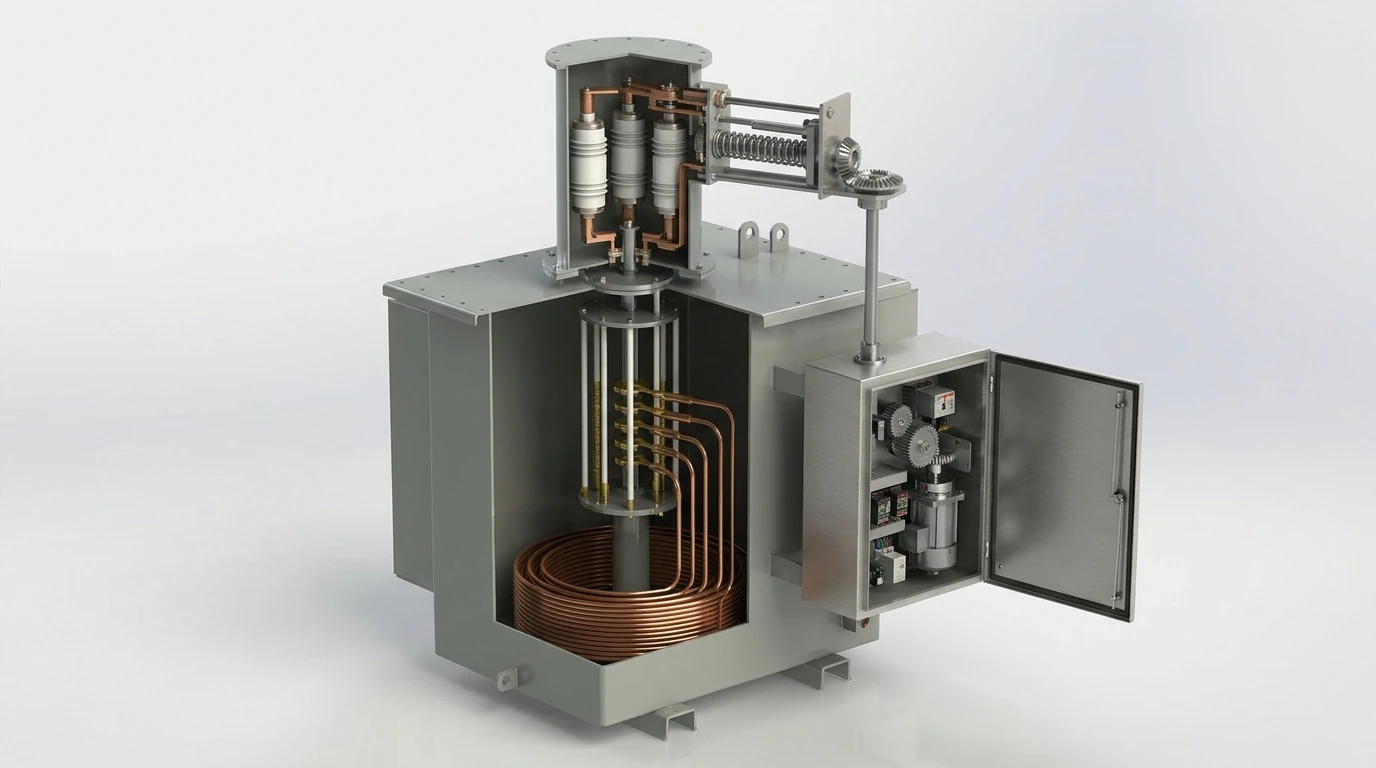
How a Vacuum OLTC Regulates Voltage Without Dropping Load
Changing transformer turns ratio while carrying hundreds of amperes requires two synchronized operations so the circuit never opens (which would cause a destructive arc) and never dead-shorts adjacent taps:
1. Tap Selector (Zero-Current)
Before switching load, the selector arm pre-positions onto the next target winding tap while carrying zero current.
2. Vacuum Diverter Switch
A spring-energy mechanism transfers load through transition resistors inside sealed vacuum interrupters in ~40–60 ms, keeping circulating current bounded and extinguishing arcs cleanly in vacuum.
APPLICATION ENGINEERING
4 Scenarios Where an OLTC Is Essential
- Solar PV & Wind Collector Substations: Compensates for rapid daytime voltage rise when active export power swings from 0% to 100%.
- Weak Rural or Mining Grids: Corrects ±10% to ±15% upstream transmission voltage sags automatically without shutting down crushers or mills.
- Mobile Emergency Substations: Allows a single 31.5 MVA 110kV mobile unit to match varying regional substation bus voltages immediately upon deployment.
- 24/7 Continuous Process Plants: Petrochemical, semiconductor, and data center campuses that cannot schedule de-energized outages for seasonal tap adjustments.
TECHNICAL FAQ
Frequently Asked Questions
OLTC POWER TRANSFORMERS
Specify Vacuum OLTC Units
11 kV, 33 kV, 66 kV, and 110 kV power transformers with ±8×1.25% Vacuum OLTC, AVR cabinet, and IEC 61850 SCADA telemetry.