
IEEE / ANSI C57.12.34 DISTRIBUTION ENGINEERING
3-Phase Pad-Mounted Transformers: Loop-Feed, Dead-Front & Protection Guide
Designed for underground utility networks, solar collector farms, EV charging plazas, and industrial parks across North America, Latin America, and 60 Hz grids. Understand compartmentalization, loop switching, and dual-element fusing before writing your RFQ.
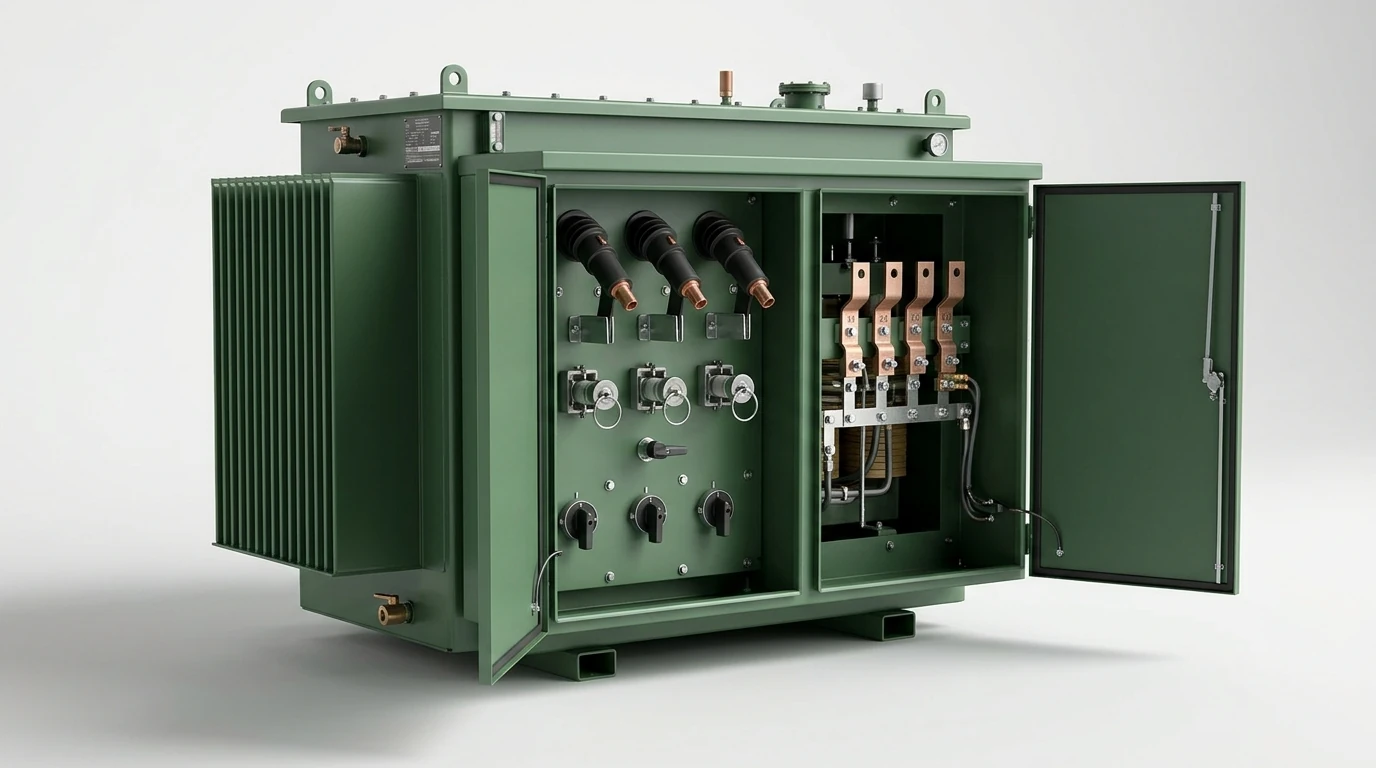
PRIMARY FEEDER TOPOLOGY
Loop-Feed vs. Radial-Feed Configurations
Choosing between radial-feed and loop-feed determines both the bushing count on the HV faceplate and how your underground medium-voltage cable ring handles outages.
| Parameter | Radial-Feed | Loop-Feed |
|---|---|---|
| HV Bushings | 3 bushings (H1, H2, H3) | 6 bushings (H1A/B, H2A/B, H3A/B) |
| Feeder Role | End-of-line spur or single dedicated feed | Underground ring main with through-feed |
| Internal Switch | Optional 2-position On/Off loadbreak switch | 4-position V-blade / T-blade or dual 2-pos switches |
| Elbow Rating | 200 A loadbreak wells & inserts | 200 A loadbreak or 600 A deadbreak bolted tees |
| Outage Recovery | Single-source; cable fault drops unit | Isolate faulted leg; restore feed from alternate side |
OPERATOR SAFETY
Dead-Front vs. Live-Front Compartments
Dead-Front (Recommended)
All medium-voltage terminations (15 kV, 25 kV, 35 kV) are fully shielded inside molded EPDM rubber loadbreak elbows bolted to IEEE 386 bushing wells. Zero energized bare metal is exposed when opening the HV cabinet door.
Live-Front (Legacy / Retrofit)
Uses exposed porcelain standoff bushings with bare copper terminals and stress-cone cable terminations. Requires wider phase-to-phase clearances and strict arc-flash PPE before opening the HV barrier.
PROTECTION & DIELECTRIC FLUIDS
Bay-O-Net Fuses, Backup CLF & FR3 Natural Ester
- Bay-O-Net Expulsion Fuse: External hotstick-operable draw-out fuse holder with flapper valve; clears secondary overloads and low-level faults cleanly without draining oil.
- Internal Partial-Range Backup CLF: Placed in series under oil inside the tank to interrupt high fault currents up to 40–50 kA symmetrically, preventing catastrophic tank rupture.
- Mineral Oil vs. FR3 Natural Ester: Mineral oil (IEC 60296 / ASTM D3487) is standard for outdoor setbacks; biodegradable FR3 / Envirotemp natural ester offers a >300°C fire point for tight building clearances and environmentally sensitive solar/mining sites.
- Tamper-Proof C57.12.28 Security: Recessed penta-head bolt latches, padlock provisions, removable door hinges, and stainless steel hardware option for coastal environments.
TECHNICAL FAQ
Frequently Asked Questions
ANSI / IEEE C57.12.34 FACTORY
Order 3-Phase Pad-Mounted Units
Custom 60 Hz / 50 Hz radial & loop-feed pad-mounted transformers with DOE efficiency compliance, certified FAT reports, and 4–6 week build times.